
The house that supplies itself — a closed-loop living system
Water falls on the roof, is filtered, drunk, reused — and never leaves the plot as wastewater. Electricity from the sun, heat from wood and compost, food from beds inside and out. A vision of the house as a closed loop — and an honest stocktake of what is possible today.
There's a thought that won't let me go. Picture a house that nothing has to go into and nothing has to come out of. No water connection, no sewer, no power grid, no oil tank. Rain falls on the roof and becomes drinking water. The shower water passes through a planted bed and comes out clean again. The sun supplies electricity, wood and compost the heat. And inside, stacked in tiers, part of the food grows — right behind the glass façade, fed by the house's own cycle.
This isn't pure fantasy. There are two schools that have been building exactly this for decades: the Earthships of Michael Reynolds, which emerged in the 1970s in the New Mexico desert — houses that handle heat, electricity, water and wastewater entirely off-grid. And in the German-speaking world Wohnwagon from Austria, who think the whole thing further in a more modern, more liveable form, with the local climate and law in mind.
I don't want to rebuild an Earthship here — the old Reynolds houses of rammed car tyres aren't my aesthetic, and they're barely permittable in Germany. What interests me is the principle behind it: the house as a closed loop, thought of like an ecosystem. And my picture of it is a modern, beautiful timber build — warm, healthy, designed — that carries these cycles within it.
This article is an attempt to think that vision through once in full. System by system. Honest about what works today. And honest about where the limits lie — legally, technically, in terms of health. Because a vision that hides its limits is no vision. It's a sales brochure.
The basic principle: cascade instead of consumption
Before we get into the individual systems, the one thought everything builds on.
In a normal house everything is a one-way street. Water comes in, gets used once, goes out as wastewater. Electricity comes in, gets used up. Rubbish goes away. Every flow runs through exactly once and disappears.
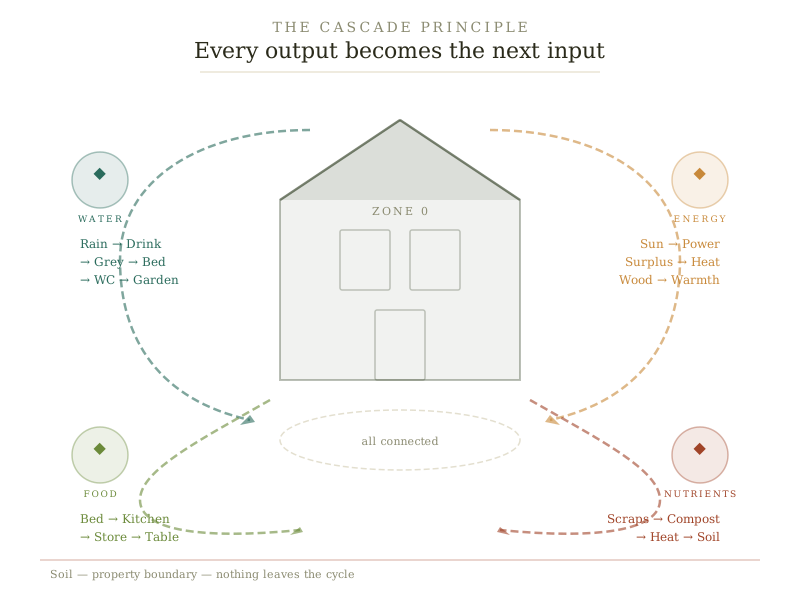
A closed system thinks in cascades. Each resource isn't used up, it's used — and then reused at the next level of quality. Drinking water becomes washing water becomes irrigation. Solar electricity becomes light, the surplus becomes hot water. Plant residues become compost become heat become soil become food. Nothing is "finished". Everything is an input for the next step.
That's exactly the same thinking as in permaculture in the garden — just carried over to the whole house. The output of one element is the input of the next. Once you've understood that, you never again see a house as a box with connections, but as an organism with a metabolism.
System 1 — Water: from the roof back into the garden
Water is the heart of it. Understand the water cycle and you understand the whole principle. It runs in several stages.
Stage 1: Collecting
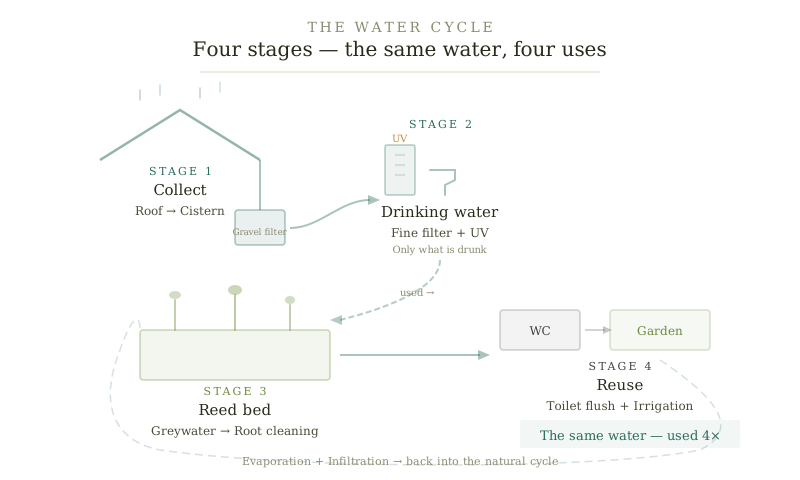
It all begins on the roof. Rain, snow, dew — every bit of precipitation is caught and led into a store. In Earthships these are mostly underground cisterns; before the water arrives there, it runs through a coarse gravel filter that holds back leaves, dirt and large particles.
A green roof here is more than looks: the substrate layer acts as a first, natural filter stage, buffers heavy rain and passes the water on with a delay and pre-cleaned. The central store can sit in the house, beside it or as a pond in the garden — Wohnwagon plans such stores individually by location: how much rain falls? How is the plot oriented? Where is the groundwater?
Stage 2: Treating drinking water
Only the water that's actually drunk goes through the full filter chain to drinking-water quality — fine filters, often with UV disinfection or further stages. That saves energy, because you don't bring all the house's water up to drinking level.
A clever detail from the Earthships: at every washbasin sit two taps — one for treated drinking water, one for plain service water. You don't wash your hands with the most expensive water.
Stage 3: Cleaning greywater through plants
Now comes the loveliest part. Greywater is the water from shower, washbasin, kitchen, washing machine — used, but not loaded with faeces. Instead of flushing it away, it's roughly freed of fats and solids and then led through a planted bed.
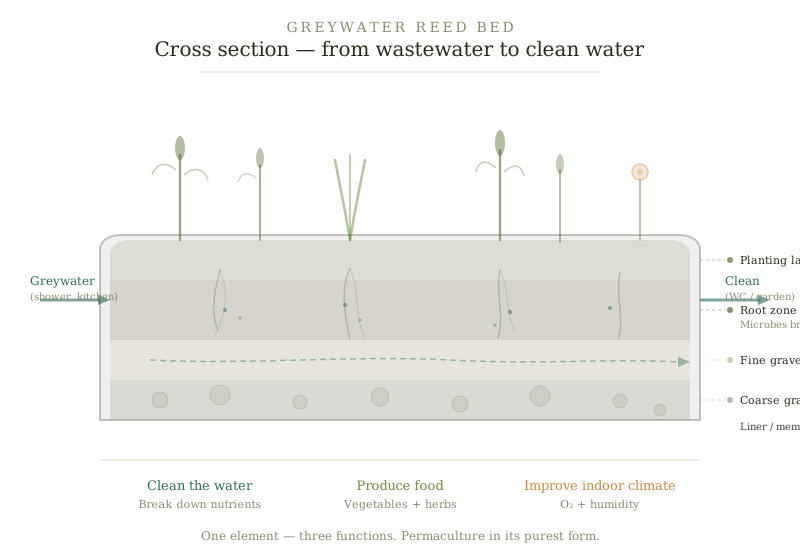
That's where the actual magic happens: plants and the microorganisms in the root space break down the nutrients — soap residues, phosphates, nitrogen — and use them as fertiliser. In the Earthship these beds sit inside, directly behind the glazed south façade. They don't just clean the water, they simultaneously produce food (vegetables, small fruit trees) and enrich the indoor air with oxygen and moisture. One element, three functions — permaculture in its purest form.
At the end of the bed the cleaned water collects, runs through a final filter and is reused for flushing the toilet. That's the third use of the same water.
In the German-speaking variant (Wohnwagon) this is called a planted treatment system (Grünkläranlage): the greywater is filtered and cleaned so it can soak away on site or water the garden — instead of flowing into the sewer.
Stage 4: The tricky subject — blackwater
And now the point where it gets serious. Blackwater is the faeces-laden water from the toilet. Here the paths split fundamentally, and here lies the biggest gulf between vision and reality.
The Earthship way: an insulated, solar-heated multi-chamber septic tank in which anaerobic bacteria decompose the blackwater. After that it runs into an external planted treatment system and is cleaned there to the point that it can water ornamental plants and trees.
The Wohnwagon way (and the more honest one for German-speaking regions): don't let the problem arise in the first place. With a separating toilet solids and liquids are collected separately from the start. Then there's simply no more blackwater — and the remaining greywater is much easier to clean. The urine is (diluted) a valuable nitrogen fertiliser, the solids are composted.
System 2 — The nutrient cycle: the humanure subject, honestly
Here I have to be clear, because this point is the trickiest in the whole concept — and because vision and law collide head-on here.
The idea behind it is compelling and ancient: with every harvest we draw nutrients out of the soil. What could be more natural than to compost human excretions — which contain exactly those nutrients — and return them to the soil? To close the loop, instead of flushing the nutrients as "waste" into a treatment plant where they become hazardous waste? In English this is called humanure, and Joseph Jenkins' "Humanure Handbook" is the bible on it. From well-composted faeces even terra-preta-like black earth can form — an extremely fertile substrate.
So much for the vision. Now the reality in Germany, and it is unambiguous:
And that has a serious reason, not just bureaucracy. Pathogens — E. coli, salmonella, parasites, worm eggs — are reliably killed only by high temperatures over a long time (real hot composting, one to two years). A normal garden compost often doesn't reach that. The 2011 EHEC outbreak with over 50 deaths is the warning of what happens when human pathogens enter the food chain.
What does that mean for the concept? Not: forget it. But: differentiate.
- Permitted and sensible: use a separating toilet, urine (strongly diluted) as a nitrogen fertiliser for non-edible plants and trees. Compost the solids and apply them in the ornamental area (hedges, trees, flowering areas) — not on vegetables.
- The grey area: the legal situation for private use in the open is actually interpreted more liberally than often feared, especially for single households. But "tolerated in a private setting" isn't the same as "permitted for growing lettuce".
- The honest line: the closed nutrient system works technically. It only becomes legally and hygienically clean once the human compost goes into the non-edible cycle and food production runs via the normal garden and kitchen compost. Anyone who wants more needs professional sanitisation — no backyard method.
This is the point where, as an association, I have to take a clear stance: we show how the loop is meant to work, and we say just as clearly where the line runs. Health before ideology. Always. How the separation works in practice is in the article on the composting toilet; the classic cycle from plant residues is described in the compost article.
System 3 — Energy: sun, wood, compost
Here the vision becomes real most straightforwardly. Energy self-sufficiency is achievable today, that's no longer a utopia.
Electricity: photovoltaics + storage
The backbone. Solar modules on the roof, a battery store (today mostly LiFePo — cycle-stable, durable, low-maintenance) for the night and dull days. Wohnwagon shows with their off-grid set that with conscious consumption and a good location 100 % self-sufficiency is achievable. Intelligent management continuously measures generation and consumption — because whoever wants to be self-sufficient has to know their own metabolism.
The nice trick with the surplus: every kilowatt-hour not needed right now travels via a heating element into an insulated hot-water store. Solar power that would otherwise dissipate becomes hot water for later. Another cascade.
Heat: wood + sun + compost
Heating runs on several tracks. A wood stove as the centrepiece — renewable, regional, storable. Ideally as a combi stove that heats the living space and warms water at the same time (Wohnwagon couples the "bathing stove" with a heat exchanger to the solar system). The passive sun through the large south glazing heats the house's thermal mass during the day, which releases the heat again at night — that's the core principle of the Earthships.
And the compost heating (after Jean Pain's principle): a large, properly set-up compost heap generates continuous heat for months through microbial decomposition — enough to pre-warm service water via embedded hoses. That's more of a supplement than a main heating, but it's a beautifully closed loop: garden waste becomes heat and then soil.
System 4 — Food: beds inside and out
The link to the core of Pranarei. The house doesn't just produce, it feeds.
Inside: the planted beds already described behind the south façade — fed by greywater, stacked in tiers for maximum area on a small footprint. Earthships even grow citrus and tropical fruit in them, because the house keeps a year-round mild climate inside. That's food production, water cleaning and indoor climate in one element.
Outside: the actual permaculture garden by zones — and here the loop closes to everything Pranarei does anyway. The 4-year rotation plan, the companion-planting guilds, the climate-specific planning. The house is Zone 0, from which Zones 1 to 5 grow outward. The garden is fed by the cleaned greywater, by the compost, by the caught rain.
Stores: and then the whole area the wild apothecary series covers — preserving, bottling, fermenting, gathering. A self-sufficient house needs the storage cellar just as much as the bed. Plan once. Harvest for decades. — here the sentence gets its greatest possible meaning.
System 5 — The build itself: timber, healthy, shielded
Finally the shell that carries all this. My vision is deliberately not a tyre Earthship, but a modern timber build.
Timber as the main building material: renewable, CO₂-storing, treated with natural oils, compostable or recyclable in the end. Wohnwagon shows that off-grid and beautiful is no contradiction — round forms, warm wood, high living comfort.
Thermal mass: the catch with timber building is that wood has little storage mass — but the Earthships' passive solar principle lives off mass (there: the earth-filled walls). A modern solution combines timber with targeted mass stores inside (clay, stone, water tanks) to have both: a healthy timber build and heat buffering.
Electromagnetic shielding: the wish for protection from radiation. That's possible structurally — via shielding materials (special clay plasters with a carbon content, shielding fabrics, earthed layers) and above all via well-thought-out electrical installation (mains demand switches, shielded cables, Wi-Fi placed deliberately). Here the honest note is important: the health effects of everyday electrosmog are scientifically disputed. But as a design principle for a consciously healthy house — minimise fields near the sleeping place, earth cleanly — it's legitimate and readily doable, quite independently of the state of the studies.
The honest limit: biodiesel and petrochemistry
Your own biodiesel production as a distant goal — independence right down to the fuel. I take this point seriously, and so I say clearly how things stand instead of glossing over it.
Technically it's possible: from plant oil (e.g. rapeseed) plus methanol and a catalyst (lye), "transesterification" produces biodiesel. Home plants for this exist. But:
- Methanol is highly toxic and easily flammable. Even small amounts can blind or kill, the vapours are dangerous. This is no kitchen-table project, this is chemistry with real injury and fire risk. This is where the DIY fun ends.
- Legally/fiscally: in Germany self-produced fuel is subject to energy tax. As soon as you designate oil for fuelling, you become a tax debtor and must register it with the main customs office. Tipping supermarket cooking oil into the tank is tax evasion — no minor offence. Since 2022 there's also no longer any tax relief for biofuel.
- The more honest self-sufficiency answer lies elsewhere: don't brew your own diesel, but make the diesel unnecessary. Electric mobility, charged directly from your own solar power, closes the energy loop more cleanly, more safely and more legally than any backyard refinery.
That's exactly the kind of limit that separates a serious vision from a prepper fantasy. We think big — and we say where thinking big stops and recklessness begins.
What of this works today — the traffic light
So that the vision becomes manageable, here's the honest classification, sorted by feasibility:
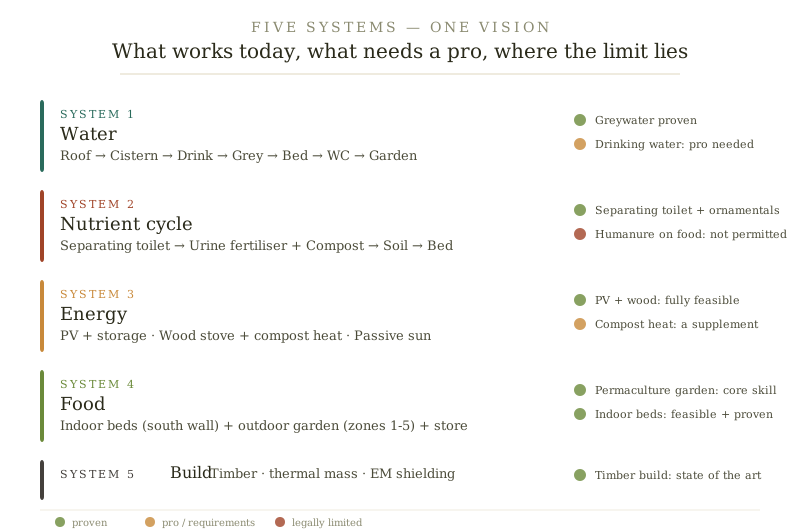
Works today, proven, recommendable:
- Photovoltaics + storage (electricity self-sufficiency)
- Wood heating / combi stove + passive solar heat
- Collecting rainwater + using it as service water
- Greywater planted treatment system
- Separating toilet + urine/compost in the non-edible area
- Indoor and outdoor food production
- Modern, healthy timber build with mass stores
Works, but with conditions / professional needed:
- Rainwater as certified drinking water
- Compost heating (Jean Pain) as a heat source
- Structural EM shielding
- Full blackwater treatment (Earthship style)
Legally/medically limited — caution:
- Humanure in food cultivation — not permitted in Germany
- Self-produced biodiesel — methanol danger + energy-tax obligation
Why all this belongs to Pranarei
You might ask: what does a self-sufficient house have to do with a garden planner?
Everything. It's the same idea, just thought bigger. The Garden Planner takes a piece of land and turns it into a considered, self-sustaining system. The closed house does the same with living. Both follow one sentence: Nature has had the system for a long time — we just have to learn to read and translate it.
The garden is the first step. It's the entry point where most people start thinking in loops instead of one-way streets. And once you've seen how the output of the compost becomes the input of the bed, you suddenly also understand why the shower water doesn't have to go into the sewer and the rain not into the drains.
Maybe that's the real vision behind Pranarei. Not a better garden planner. But people relearning to live in closed loops — starting with the bed, one day with the whole house. Not out of fear. But because it makes sense. Because it's more beautiful. And because the best time to start was yesterday — and the second-best is today.
Whoever wants to start with the bed starts in the Garden Planner.
Note: this article describes a concept and reflects the state of established projects (Earthship, Wohnwagon) as well as the legal situation in Germany. It is no substitute for professional planning. Anyone wanting to implement parts of it should speak with specialist firms, the responsible building authority, the water management office and the main customs office (for fuels). Particular caution with: human faeces (hygiene/law), drinking-water treatment (Drinking Water Ordinance) and any form of fuel chemistry (methanol life-threatening, energy-tax obligation).
Editorial responsibility: Simon Graf, Pranarei n.e.V.
Build your complete permaculture plan in 5 minutes — with 4-year crop rotation, intercropping and climate-specific tips.
▸ To the garden planner