
Adapting the Three Sisters for Central Europe
The classic indigenous companion planting of corn–bean–squash is brilliant — but corn does not thrive everywhere in Central Europe. Here is how to adapt the principle to your climate zone.
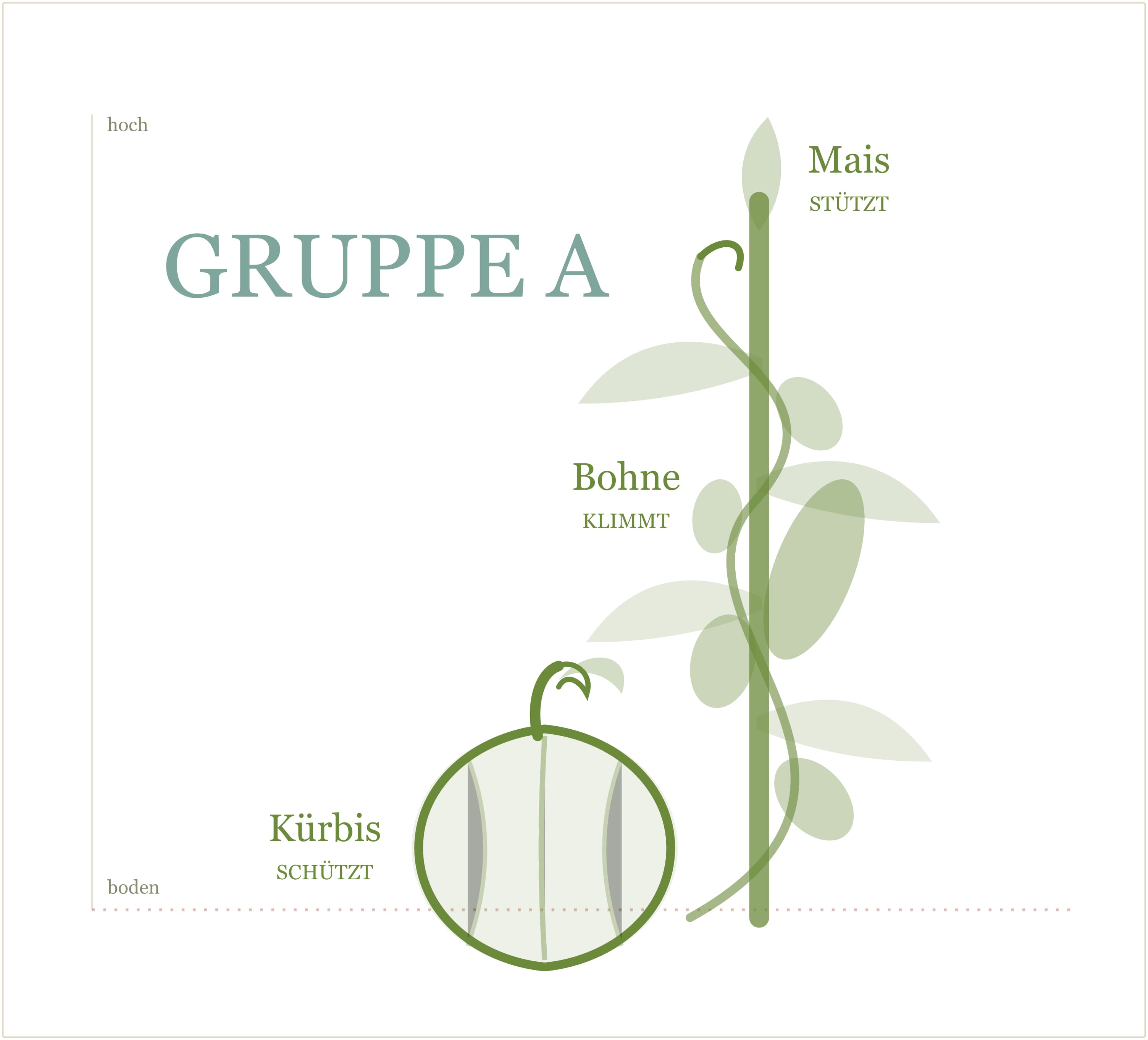
The Three Sisters is the most famous companion planting in the world: corn, beans and squash on the same bed. Developed by the indigenous peoples of North America at least 3,500 years ago — and still a textbook example of permaculture that works. In Central Europe, though, the corn makes trouble. Here is how to adapt the principle pragmatically.
Why it works
The three plants complement each other on three levels:
- Corn grows tall and straight — a climbing frame for the beans.
- Beans fix atmospheric nitrogen through root bacteria (rhizobia) and so feed corn and squash in the same breath.
- Squash spreads its large leaves across the ground — shading the soil, holding moisture, crowding out weeds. Living mulch.
Plus: all three store well after the season (dried beans, dried corn, winter squash) — a single Three Sisters bed could carry a family through the winter.
The problem in Central Europe
Corn needs warmth. We don't get the long, hot summers you find in Mexico. In climate zones 6 and 7 (which is most of Germany) corn is borderline — it often fails to ripen in time or stays too short to give the pole beans enough support.
In zone 8 (the Upper Rhine, the Lower Rhine) the classic Three Sisters works. Everywhere else an adaptation pays off.
Adaptation for Central Europe
Option 1: replace corn with sunflower
In our climate sunflowers reliably reach 2 metres and make just as good a climbing frame for beans as corn. Bonus: the flowers draw bees and hoverflies, and you can harvest the seeds in autumn (or leave them for the birds). Varieties: Helianthus annuus 'Giganteus' or 'Sungold Tall'.
Option 2: corn on the south side
If you live in zone 7 and want to try corn: plant it in the warmest spot in your garden (south wall, stone wall, south-facing slope) and choose an early-ripening variety ('Golden Bantam','Painted Mountain'). 90 days instead of 110.
Option 3: replace corn with Jerusalem artichoke
Jerusalem artichoke (Helianthus tuberosus) grows 6.6 ft–9.8 ft tall, is completely hardy, and yields edible tubers in winter — corn height without the warmth requirement. Just be careful: Jerusalem artichoke spreads aggressively, so contain it well.
Layout — how to build the bed
A classic Three Sisters bed is 4.9 × 4.9 ft. At the centre a small mound (soil + compost). Around it:
- Step 1 — May: sow 3–4 corn/sunflower seeds into the mound. 3.9 in spacing between the seeds.
- Step 2 — 2 weeks later: once the corn is 5.9 in tall, direct-sow 4–6 pole beans around the mound. Make sure you use a bean inoculant — it activates the nodule bacteria and boosts the nitrogen effect by 30–50 %.
- Step 3 — at the same time: 3–4 squash seeds at the edge of the bed. They trail outward and shade the soil.
What to avoid
- Sowing the beans too early. If the corn/sunflower has no height yet, the beans cling to anything that moves — and overgrow the others.
- Fertilising with nitrogen. The beans supply the nitrogen themselves. Extra fertiliser only drives leaf mass, not fruit.
- A bed that's too small. Under 3.9 ft square the system doesn't work — the squash needs room and the corn needs height.
In the Garden Planner
In the Garden Planner we use an adapted Three Sisters concept as Group A(beans + squash in alternating rows). Corn is optional depending on zone — in the full version you can specify whether you want to grow corn or one of the alternatives.
Editorial responsibility: Simon Graf, Pranarei n.e.V.
Build your complete permaculture plan in 5 minutes — with 4-year crop rotation, intercropping and climate-specific tips.
▸ To the garden planner