
Permaculture zones 1 to 5 — explained for the hobby garden
Bill Mollison invented the zones for self-sufficient homesteads. They pay off in the 200 m² garden too — as a rule of thumb for what goes where and how much care to expect in each place.
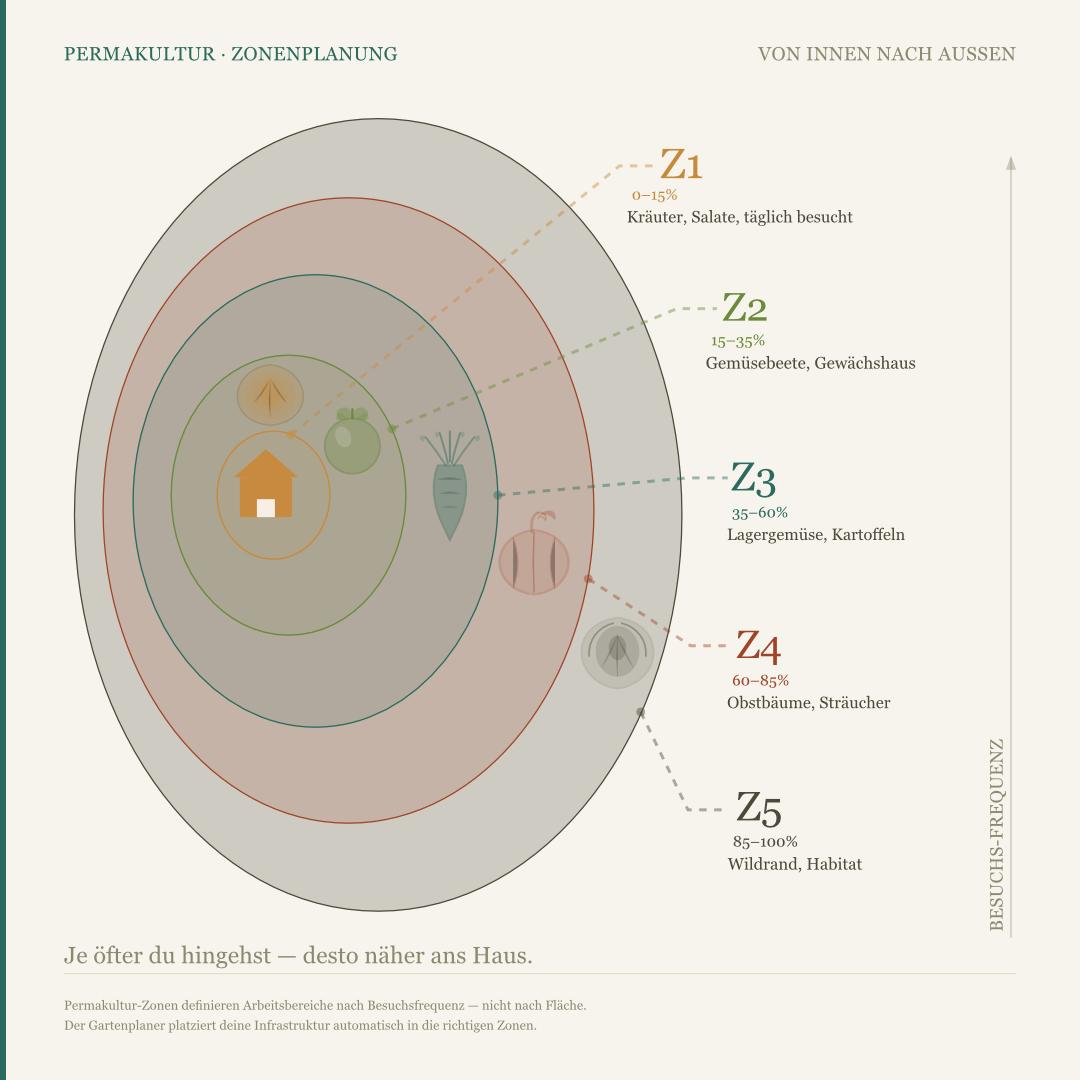
Permaculture zones are one of the oldest and most practical concepts of the movement — developed by Bill Mollison and David Holmgren in the 1970s. At heart it's a rule of thumb for the question: what goes where?
The basic idea
The closer something is to the house, the more often you visit it. The more often you visit it, the higher the care intensity can be and the more spontaneous the harvest. From that come 5 zones — from the intensively tended area near the house out to the wild edge.
Zone 1 — close to the house
Distance: 0.0 ft–32.8 ft from the house
Care: daily
Here go the things you need often: kitchen herbs, salads, cut-and-come-again lettuces, small spinach/chard plantings, cutting herbs. Raised beds are ideal — comfortable to work, visually part of the living surroundings.
Gardener's logic: when you need 5 sprigs of parsley while cooking, you shouldn't have to walk 164.0 ft across the garden.
Zone 2 — the main vegetable garden
Distance: 32.8 ft–98.4 ft
Care: weekly to daily
The heart of the vegetable garden. Here run the rotation beds for tomatoes, beans, squash, cabbage, root vegetables. The greenhouse belongs in zone 2 too — you have to ventilate, water and harvest regularly.
Plant groups with similar care needs are placed together (companion-planting guilds A to D in the Garden Planner). Lay out the path system so that no bed is more than 2 steps from the main path.
Zone 3 — storage crops + self-sufficiency
Distance: 98.4 ft–328.1 ft
Care: monthly
Things you plant once and harvest once: potatoes, planting-bucket maize, storage squash, storage onions, garlic. Orchard fruit also begins here (apple, pear, plum).
In a small hobby garden under 3,229 sq ft, zone 3 often blurs into zone 2. On a self-sufficient homestead it's the actual bread-and- butter area.
Zone 4 — the semi-wild area
Distance: 328.1 ft+
Care: yearly
Berry bushes, wild fruit, walnut, perennials that maintain themselves. Little intervention happens here — mulching and mowing are enough.
In a hobby garden under 10,764 sq ft it's rather symbolic. But the concept is useful: one corner of the garden is allowed to be "semi-wild".
Zone 5 — wilderness
Distance: the outermost edge
Care: none
Zone 5 stays uncultivated. A refuge for wildlife, insects, fungi, wild herbs. Even on small plots there should be a piece of zone 5 — a wild hedge, a deadwood pile, a nettle corner. That isn't "neglected" but deliberate.
From zone 5 come valuable services: pollinators, natural pest controllers (ladybirds, hedgehogs, birds), wild herbs that keep the soil alive.
Arriving in the hobby garden
In a 2,153 sq ft garden the zones have practical rather than spatial meaning. Rule of thumb:
- 10 % Z1 — raised bed near the house, herbs, salads
- 40 % Z2 — main beds, greenhouse, rotation
- 30 % Z3 — potatoes, planting buckets, storage crops, fruit tree
- 10 % Z4 — berry bushes, wild fruit, possibly a compost heap
- 10 % Z5 — wild corner, deadwood, unmown edge
In the Garden Planner
The Garden Planner uses the zones automatically — the map shows your plot with Z1–Z5 rings radiating out from the house pin. Infrastructure is placed zone-correctly: raised beds to Z1, rotation beds + greenhouse to Z2, potato planting buckets to Z3, orchard fruit to Z4. You can move the house pin — the zones recalculate.
Editorial responsibility: Simon Graf, Pranarei n.e.V.
Build your complete permaculture plan in 5 minutes — with 4-year crop rotation, intercropping and climate-specific tips.
▸ To the garden planner